 AERELONTECH
writing
Return to the form where I succeeded the most
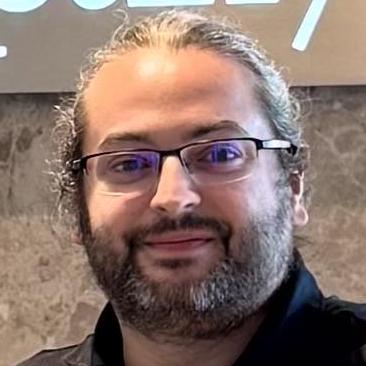
Over 2024 to early 2025 I wrote my first book. I planned doing that for over a decade. Created endless notes of my sci-fi world, its history, the outlines of story ideas I want to tell. One thing still didn’t happen over long time, and that was the most basic thing: to actually write.
Creating in public seems to be my secret sauce
One day, didn’t even looking for a new hobby, just watched a video that really connected with me. Being an engineer, I am fascinated by its world, even other areas than mine. This is how I watched almost all air crash investigation content and still love flying after well over the hundredth time. As a passanger.
When I ran out of those content, somehow dear youtube algorithm suggested another channel, Brick Immortar, but he was about ship catastrophes. That was just something new, I got primed for it by the Internet Historian’s piece about the Costa Concordia, so I dived in. Halfway watching Brick Immortar’s story about the ferry lost near South Korea, I had a new idea.
What if the NTSB would be needed in the far future? How an investigation would look like for a faster than light spaceship? A rescue mission? I thought it is a wild idea, noone would care about it, so… it was perfect. Placed in the world I was building for a decade, this gave a no-risk opportunity to just start writing.
And so I did. In less than an hour, I had my first scene online on medium.com. No edit, just around 3 pages, but gave a noir-hard-sci-fi, bit of cyberpunk vibes. Then posted about it, then to force myself to actually finish what I started, posted that I will write weekly. 60 weeks later, my 80.000 word manuscript was published, online, for about 5 returning readers and plenty more occasional readers.
That was almost a year ago, and I made no visible progress. You know, the first manuscript is usually not very good. And requires a lot more work to make it a real book, an enjoyable experience for readers.
I really liked working on it, and felt immense accomplishment when I was able to say, I finished it, and I wrote a book.
Here I am, returning to this project, to finally give it the polish it needs.
Due to publishing on medium.com, the first global publishing right was already done, however, I don’t know how the editing process will affect that. It may return to me and can publish it traditionally. Don’t know.
Anyhow, I can make it self-published. The accomplishment of having written my first book is enough for me for this run.
I may return with another book(s), after this one is done.
However, small progress, yet I learned critical lessons during that off-year, read on to hear about my experience:
- I hired two beta readers, Americans, so I can get native feedback;
- Found a great course on udemy, from an ex-Wall Street Journal editor about how to write with flair and I can apply the learnings to fiction stories;
- Bought a book about editing and the first chapter already taught something I could not find otherwise;
- And finally, I printed at a copy shop my own manuscript, forcing me to format the whole text I should have done way earlier.
Beta reading is an expensive necessity
Good and informative beta reading is not easy to come by. Family, friends, the occasional reader on the internet can only get you so far. At a point, professional needs to be hired.
During 2025, I did just that, budget out a run, two separate reader, each was 500 USD. I got a 10-page, detailed critic from both of them and it was the so much needed mirror for my little creation and my skills as a writer.
Summarizing it, they pointed out many flaws:
- Format: was unusual, hard to read and I forgot some TODOs in!
- Grammar: plenty of grammatical errors made it a chore to read through my book.
- Plot speed: too much bogged down at the middle for the repair tasks around the ships and not enough drama!
- Flat characters: nor personality, nor unique voice, they all blended together, and had no space to shine.
Mainly these above points I will focus on solving in the short term. Read on for my immediate learnings and what I did to apply them!
I will be honest, at first I dreaded this part. The inner voices… what if all of it is terrible? Others will have a negative opinion of me… But this is all in my head. I knew I needed honest feedback or I can’t make it better. And after all, they were professional and focused on the product, not on personal feedback.
It is easy to take feedback personally even if it is not about you as a human. Fortunately I grew up in a great professional environment.
“The best end of year gift you can get from your colleagues is an honest and actionable feedback.”
One of my best leaders ever used to say that and always lived by it. Honesty grows us, don’t run away from a criticizism. It always comes from caring. Silence or no feedback is worse, that signals apathy.
While it was not just doom and gloom, they praised the story and the overall plot in multiple ways. They liked how the criminal elements were behind the accident, even wished I spend more time on the smuggling subplot.
One of my main mission was to create a loop structure, to start in the future and come back again to it, then lead into an epic showdown where all threads matter and the beta readers appreciated that!
I plan to repeat the experience with new beta readers after the revision of the above points are done, can’t wait for the new critics, hope it will be as sharp as before!
Simplicity in language makes reading easier.
Used Udemy before, mostly for game dev courses. Some marketing courses and business ones before, nothing really outstanding, though some were great quality. When I searched for writing courses, I expected a large amount of low quality, early, not yet successful writers to make most of the content. I wasn’t entirely wrong, but I found some great gems.
The ex-Wall Street Journal editor, Shani Raja’s “Writing With Flair” first sounded too fancy to be true. Then I watched the examples and it was gripping. He had a great speaking style, the writing experience truly shined through. One of my best value for money on Udemy ever.
Udemy: Writing With Flair by Shani Raja
A sleepless night/morning, 4am, I went through most of the first block. His course is structured around four key pillars:
- Simplicity
- Clarity
- Elegance
- Evocativeness
In “Simplicity”, he showed the principles he uses as an editor. While these are aimed at news of the world and fast-paced reading of low attention spans, the techniques are super useful for any writing!
For example, unnecessary ceremony detracts from the point, e.g. capitalizing words that are otherwise not grammatically necessary to be. Or to remove words that add no value, or state the same thing other, more important words already hold.
After learning about “Simplicity”, I made a few decisions:
- For narrative text, I will use simplicity as much as possible, when it does not go against painting a picture!
- For characters’ speech, I can now use a few tricks to create their “voice”. One could be using the journalist like simple, to the point talks. The other will always add some unnecessary ceremony, etc. I still need to think what each “technique” could communicate about the person who uses it.
I can’t wait to get to the “Evocativeness” chapter, that feels like the most important as a fiction writer, however the journey matters most here!
Found my source to learn how to edit, finally.
Searching for books about a topic on Amazon can be a drowning experience. Much more written content is published every day than what we can ever consume in a lifetime! This is great, but creates another problem: which one is worth to consume?
Reviews can barely help sometimes, overly positive reviews are too eagerly written, and even if a critique is well written, you end up reading more of those than actual books if you aren’t careful!
My personal tactic is to find 5-10 books in one round of search and send the free version to my Kindle app. Next downtime, a bus, transit, flight, whatever, I read as much of those as I can. Then decide by feeling and value earned from the beginning if I buy it.
This time I got very lucky: took the free sample for “Write, Edit, Publish: what every writer needs…” and after the foreword by the author, he already delivered value: his editorial experience shows, how often authors start with a boring sentence. And a boring paragraph. And nothing happens until pages in.
He wrote, kick off the story with something unusual. Not with the morning brushing, but the same everyday “hero” in the moment when his life turns upside down. Or a not everyday place, action, scenario that keeps the reader interested.
I knew my story started relatively well, albeit it could feel a bit boring still:
“Sir, it’s your turn, 2 minutes” told the bailiff to John as he was sipping his coffee, barely looking up as just another day in the never-ending litigations after the accident.
I think the initial picture still creates interest and leaves some questions open in the reader’s mind:
- What this John needs to do in two minutes in a jail or at court?
- What accident happened that is being litigated?
- Why is he even bored by this? What did he do?
First, I could make it simpler to read and paint a bit more instead of being so factual:
“2 minutes” tossed out the bailiff.
John barely looked up from sipping his coffee. His thoughts circling around the accident being litigated forever. Released a quiet sigh as he slowly rised, the weight of yet another testimony pushing him back to the back-breaking metal chair.
Could try to not start with a dialogue immediately:
John barely looked up from sipping his coffee when the bailiff cracked open the door.
“2 minutes and your turn.” he tossed out the instructions.
As thoughts circled around the never ending litigations of the accident, John rised slowly from his back-breaking chair. Released a quiet sigh as the unwanted weight of fighting for justice fell upon him. He lost count of the testimonies he had to give over the years, hoping this is the last one.
One last attempt to simplify the initial paragraphs:
John kept fiddling with his badge as the bailiff tossed out:
“2 minutes and your turn!”
He rised slowly, thoughts circling the accident he has to testify about. Losing count of the court proceedings his expertise was required over the years.
I could move away from the starting point to another entry to the story, maybe at a more apt time for wits colliding:
“Thousands of lives could be saved if the emergency system shuts down the engines, as they should have.”
“Objection, witness is speculating.”
“Your honor, witness is the investigation’s lead expert, hence he is allowed to speculate on proven facts.”
What do you think, which version would pull you in for the ride?
Next is to revisit my plot structure. Feedback was about the pacing, the time delays of years were not helping either. So on to the three act structure and how my plot beats fit into it.
Back to oldschool, a paper-in-hand still beats the digital.
As a software engineer, strategy consultant turned CTO, digital is in my blood. Yet, there is no better way to feel a real achievement than holding the physical representation of your work in your hands. For this, I decided to get a printed version of my manuscript to work on. The old school pen and paper still has its magic.
I didn’t expect to have so much done for a single printing. It costs some measurable money, hence I wanted to improve the text as quickly and as much I could before printing.
Originally I wrote in Ulysses and then used its export functionality to Word to share with the beta readers. And here where things went a bit worse, the export messed up multiple aspects:
- The markdown representation yielded non-breakable new lines, hence nothing was in their proper paragraphs.
- The markdown TODO marks did end up in the export despite my expectations. Most I manually deleted, some stayed over the 80k words.
- Plenty of grammatical errors weren’t caught by Ulysses integrated checks, in Word, I’ve been welcomed by ~500 grammatical errors marked.
After some manual fixing of two major format errors, I found better ways.
If you use special characters in the find all and replace, you could quickly fix this.
Another formatting lesson, as a Hungarian, I read and learned that dialogue was formatted with a dash and quotes to separate from interjections, e.g. like this:
- “Hi!” - said Jack.
But this is weird in English worlds, they have the simpler format of:
“Hi!” said Jack.
This is not about which format is better, it is cultural. One culture is used with one type, so their reading is faster and more comfortable when they read along their expectation.
Then I used the side panel of Word to locate the grammatical errors and make a decision how to fix them. 90% of the time I accepted the proposed solution, in the remaining cases I reworded sentences as the grammatical error was coming from not understanding what I was trying to express.
Only once I ran into the issue that the grammar suggested a fix, applied it, then the grammar suggested another fix! Applied that too, and the first fix suggestion returned, leading to an infinite loop! How far machines can go without human decisions 🙂.
Still, one fun fact I didn’t pay attention at this point was the Flesch-Kincaid scale. I just wanted a statistics data about how much I changed the pages and word count, so I did ask for the stats before my work and after. The surprise was that fixing the ~500 grammatical errors actually lowered the score from 9th grade to 7.5th grade!
Without any extensive rewrites or edits, the level of writing is at the best position for me. I think 7th to 8th grade reading capability is exactly my target audience level with a hard science-fiction novel.
Took a week of evening hours, and a bit of travel to the copy shop, then 10 minutes wait for my manuscript:
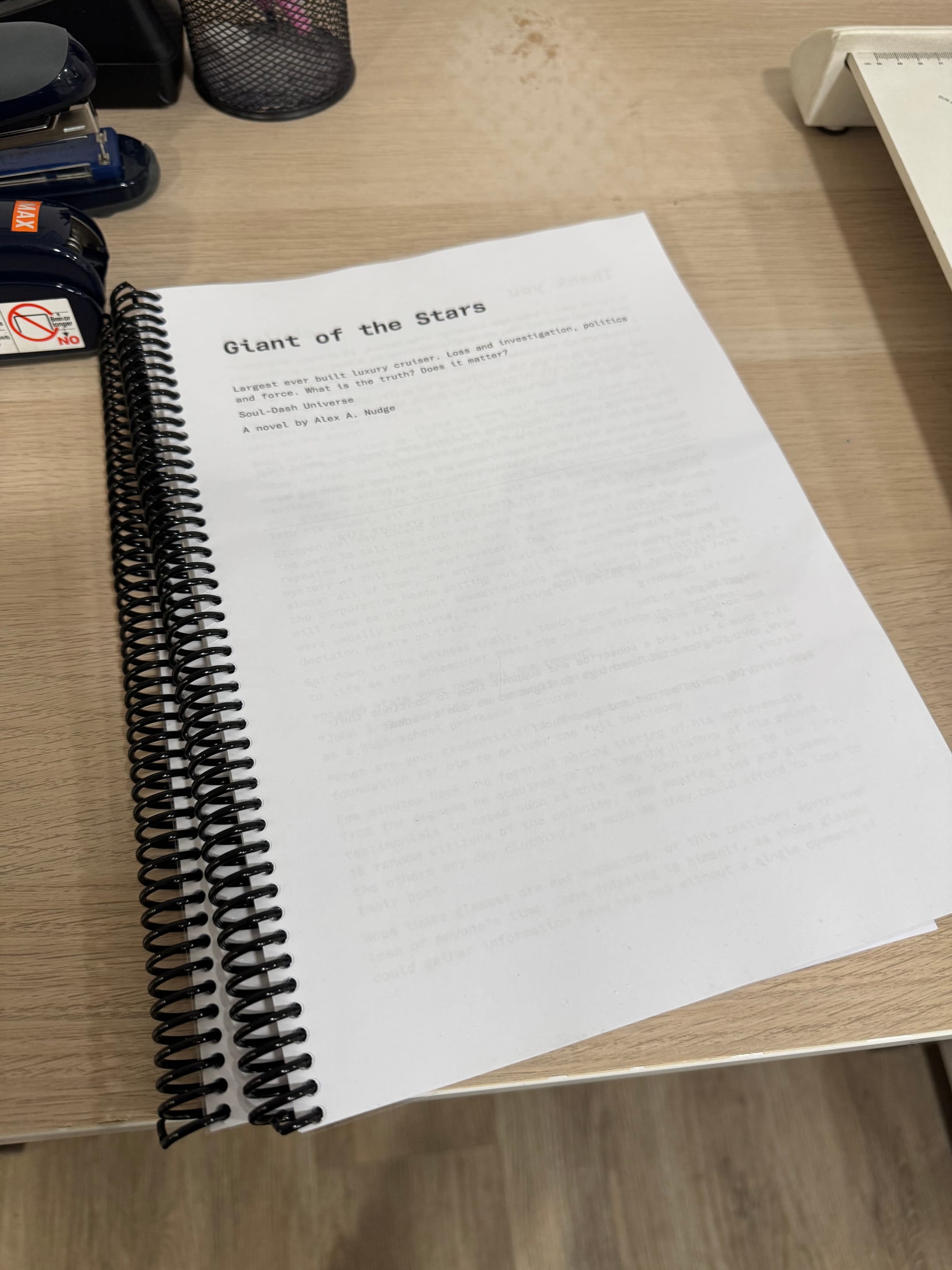
Heart skipped a single beat when I could hold it in my hand, hiding my emotional turmoil from the unsuspecting photocopier.
All in all, long journey ahead.
Another year. I see a lot of editing, re-editing, scrapping scenes and rewriting in my near future.
It would be daunting, if it wouldn’t be exciting.
Creating something out of thin air, be it software or a written book, it provides the same excitement of building an experience for others.
Wish me luck, and I keep you all posted how I progress.
Besides these writing updates, I write about tech, leadership and gaming topics, however my time allows while building my company. If interested, give a subscribe here and you will get my articles into your inbox, whenever they are published!
Happy new year, sayonnara and goodbye, until next time!